1. Executive summary
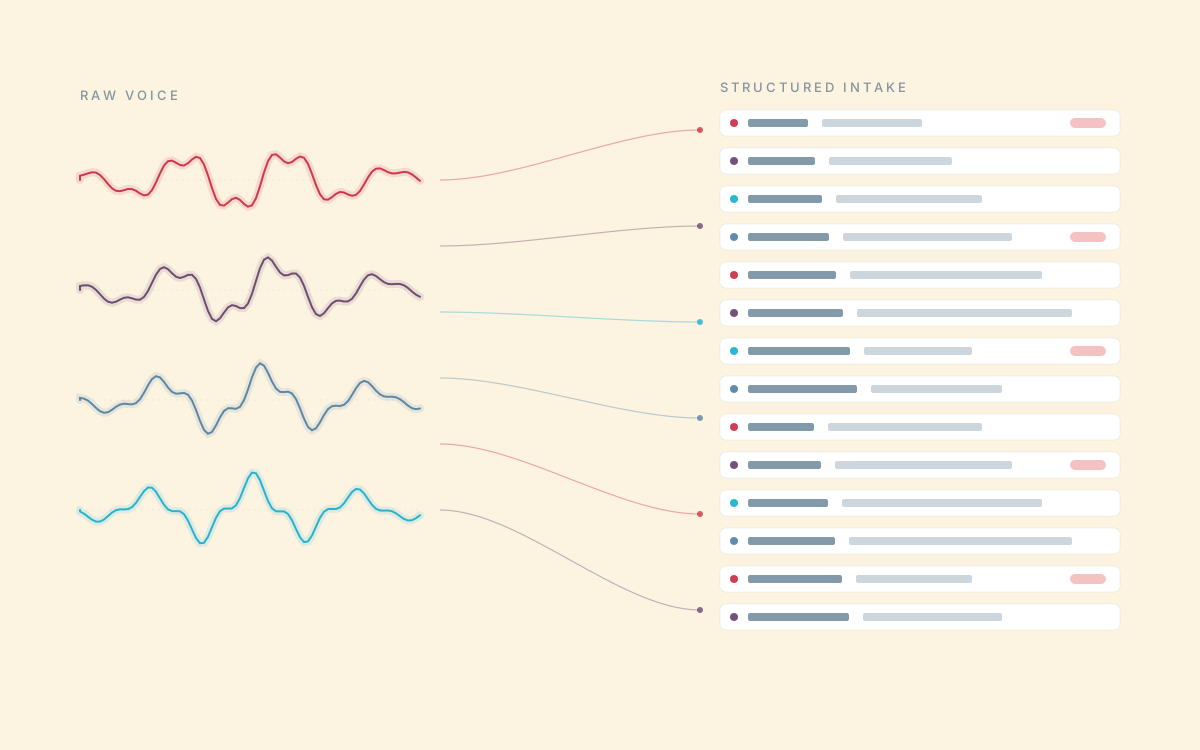
The time between a patient's first contact with a mental-health service and a clinically useful diagnostic assessment is dominated not by clinical reasoning but by information collection: demographics, insurance, symptom history, prior treatments, current medications, risk screens, and standardized scales. When this work is folded into the same hour as the diagnostic interview, two consequences follow. The clinician's expertise is spent on data entry. And the patient's narrative is compressed into whatever minutes remain.
This paper argues that conversational AI — natural-language agents that conduct structured information-gathering before the diagnostic assessment — addresses a problem the field has long named but rarely measured. We make the argument in four steps. First, we show that documentation and information-gathering already account for the largest single share of clinician time in ambulatory medicine, with a documentation burden that has worsened, not improved, over the past decade (Sinsky et al., 2016; Rotenstein, Apathy, Holmgren, & Bates, 2023). Second, we show that the asymmetry between patient disclosure to humans and to computer-administered interfaces is one of the most reliably replicated findings in clinical measurement, holding across forty years of self-report-mode research and re-emerging clearly in modern virtual-agent studies (Turner et al., 1998; Lucas, Gratch, King, & Morency, 2014; Lucas et al., 2017). Third, we show that unstructured clinical intake produces unreliable diagnoses: median agreement with structured reference standards sits in only the fair-to-moderate range, far below what most clinicians assume, meaning a substantial fraction of routine diagnoses are wrong by the field's own gold standard (Rettew, Lynch, Achenbach, Dumenci, & Ivanova, 2009). Fourth, we show that recently published evidence on AI scribes and AI screening — including a JAMA cohort of more than eight thousand clinicians — demonstrates measurable, replicable reductions in documentation time without compromising visit quantity (Rotenstein, Holmgren, Thombley, et al., 2026; Olson et al., 2025).
The argument is not that AI replaces clinical judgment. It is that automating the part of intake which is not clinical judgment — the part already performed by typing — gives the clinician back the hour they were trained for.
2. The pre-assessment bottleneck
Information collection in psychiatry is unusually expensive because it is unusually relational. A patient disclosing self-harm to a paper form behaves differently than the same patient disclosing it to a clinician (Podlogar et al., 2015). A clinician hearing the same disclosure under the pressure of a 45-minute slot prioritizes differently than one hearing it during structured intake (Miller et al., 2001). Both modalities carry costs. Forms produce non-disclosure precisely on the items where disclosure matters most. And clinician-administered intakes consume the very minutes meant for differential reasoning.
The clearest measurement of the time cost remains Sinsky and colleagues' (2016) time-and-motion study across four ambulatory specialties. During the office day, physicians spent 27.0% of their total time on direct clinical face time with patients and 49.2% of their time on EHR and desk work (Sinsky et al., 2016, p. 753). The ratio is striking: for every hour of direct face time, physicians spend nearly two additional hours on EHR and desk work within the clinic day, plus one to two hours of after-hours work each evening, devoted mostly to the EHR. Subsequent EHR-metadata studies on hundreds of thousands of clinicians have replicated and refined the pattern: physicians in the top decile of note length spend 39% more after-hours time in the EHR and close 5.6 percentage points fewer visits on the same day (Apathy, Rotenstein, Bates, & Holmgren, 2023). The closest peer-reviewed proxy for psychiatric documentation burden specifically — a 2023 study of the developmental-behavioral pediatric workforce that included pediatric psychiatry as a comparator — found that documentation burden in this discipline exceeded that of similar provider groups (Patel et al., 2023). No high-quality, modern, US time-motion study of outpatient psychiatry has been published; the absence of such data is itself a finding.
The relational economics are sharpened by the workforce context. As of December 2024, more than 122 million people in the United States lived in a Mental Health Professional Shortage Area (HRSA, 2026). The percentage of psychiatrists accepting commercial insurance has fallen below that of any other specialty studied, with 55.3% acceptance versus 88.7% for other physicians in the most recent national data (Bishop, Press, Keyhani, & Pincus, 2014). Burnout among the behavioral-health workforce has reached crisis levels: in a 2023 survey of 750 behavioral-health professionals, 93% reported having experienced burnout (HRSA, 2025). In a 2024 mystery-shopper audit of community mental-health centers, callers seeking an appointment for an adolescent could schedule one in only 17% of contacts; the most common reason for denial was capacity (Adams, Pérez-Flores, Mabrouk, & Minor, 2024).
The intake is the most expensive form-filling exercise in the modern clinic. The pen happens to be a clinician.
3. What the evidence says
Three converging streams of evidence motivate moving structured information collection upstream of the assessment.
3.1 Patient self-disclosure to conversational agents is higher than to humans on stigmatized content
The asymmetry has been documented across two distinct literatures: audio-computer-assisted self-interviewing (ACASI) in epidemiology and conversational-agent disclosure in clinical research.
Turner and colleagues' (1998) seminal Science study of adolescent risk behavior found that estimates of the prevalence of male-male sex, injection drug use, and sexual contact with intravenous drug users were higher by factors of 3 or more when audio-CASI was used compared with paper self-report (Turner et al., 1998). The pattern has been replicated repeatedly in adult populations across substance use, sexual health, and HIV-risk contexts (Adebajo et al., 2014; Islam, Topp, Conigrave, et al., 2012). On suicidality specifically, Podlogar and colleagues (2015) demonstrated that respondents who decline to answer suicide-risk screening questions score similarly to those who endorse suicidal ideation on validated suicide-risk measures, meaning that nondisclosure for suicide risk screening questions is a preferred option for a distinct group of respondents who are likely at elevated suicide risk (Podlogar et al., 2015, p. 970). The patients most relevant to detect are the ones most likely to skip the relevant items on a form.
Lucas and colleagues (2014) extended this finding to embodied conversational agents. In a controlled experiment, participants who believed they were interacting with a computer reported lower fear of self-disclosure, lower impression management, displayed their sadness more intensely, and were rated by observers as more willing to disclose than those who believed the same virtual interviewer was operated by a human (Lucas et al., 2014, p. 94). In the strongest field test of this effect to date, Lucas and colleagues (2017) compared active-duty US service members' symptom reporting to a virtual human against their reporting on the identifiable Post-Deployment Health Assessment; service members disclosed more PTSD symptoms to the virtual interviewer than on the official form they knew their command would read. Pickard, Roster, and Chen (2016) found that participants preferred avatar interviewers for the most sensitive topics, with the conditional caveat that for low-sensitivity topics, human interviewers were preferred. The mechanism appears to be perceived non-judgment.
Recent work on label-avoidance — the desire to avoid being identified as someone with a mental-health condition — has shown that label avoidance is a significant negative predictor of care-seeking through traditional channels and a significant positive predictor of willingness to engage with a mental-health chatbot (Kosyluk, Baeder, Greene, et al., 2024). The chatbot, in this account, is not in competition with the clinician; it is in competition with silence.
3.2 Computer-administered intake is at least as complete as the alternatives
The 2020 systematic review and meta-analysis by Jibb and colleagues, covering 72 studies of electronic versus conventional patient-reported data collection, found a weighted correlation between electronic and conventional pain scores of 0.92 (95% CI, 0.88–0.95), with electronic collection equivalent or superior on data completeness, ease of use, and efficiency (Jibb et al., 2020). The Cochrane review by Marcano Belisario and colleagues (2015) similarly concluded that mobile-app self-administered questionnaires produced more complete records than paper. In a randomized comparison of telephone interview against mailed paper questionnaires, the telephone modality yielded 0.5% missing data versus 2.8% on paper (Lungenhausen et al., 2007). In ambulatory pediatrics, a pre-visit electronic tablet nearly doubled the rate of adolescent self-reporting on sensitive items, with a 19.3-percentage-point increase from a baseline of 20.5% (Grout, Cheng, Aalsma, & Downs, 2019).
The completeness argument extends to the structured diagnostic interview itself. The MINI-Kid identifies a median of three disorders per subject compared with two on the longer K-SADS-PL, and does so in roughly one-third of the administration time — 34 minutes versus 103 (Sheehan et al., 2010). Structured information collection is not slower than unstructured collection. It is faster, more complete, and more reliable — provided the patient is willing to disclose, which Section 3.1 establishes they are more willing to do when the interviewer is a computer.
3.3 The marginal value of clinician time during intake is in formulation, not capture
The most important and least appreciated finding in this literature is the gap between unstructured clinical diagnosis and structured reference standards. Rettew and colleagues' (2009) meta-analysis of agreement between clinical-evaluation diagnoses and standardized diagnostic interviews reported a median κ of 0.48 across specific disorders — fair to moderate agreement — with mean κ for the broad "any disorder" category of only 0.27 (Rettew et al., 2009, p. 169). In a head-to-head inpatient comparison, traditional unstructured intake produced 53.8% diagnostic agreement (κ = 0.43, "fair") versus 85.7% (κ = 0.82, "excellent") for the SCID administered by the same clinicians on the same patients (Miller et al., 2001). The JAMA Rational Clinical Examination meta-analysis on the diagnosis of depression reached the same conclusion: semistructured interviews yielded κ of 0.64–0.93 across studies, while nonstandardized interviews yielded κ of 0.55–0.74 (Williams, Noël, Cordes, Ramirez, & Pignone, 2002). Zimmerman and Chelminski (2003) documented systematic under-detection of comorbid anxiety in routine evaluations of depressed outpatients. Bruchmüller, Margraf, and Schneider (2012) showed that unstructured clinical judgment produces demographic bias in ADHD diagnosis that structured criteria do not.
This is the central point. The clinician's hour is not equally valuable across all of its constituent tasks. The part of the hour spent capturing demographics, prior medications, symptom inventories, and screening scores is a part the clinician performs with no diagnostic advantage over a structured tool. The part of the hour spent on diagnostic formulation, risk stratification, alliance, and treatment planning is where the clinician's training has irreplaceable value. Reallocating the first to a conversational agent preserves the second.
The bottleneck isn't the diagnostic. It's everything that happens before it.
4. Defining intake quality
"Quality" of an intake is often conflated with "completeness." We propose a four-part operational definition that any conversational intake system — and any traditional one — should be evaluated against.
Coverage. The proportion of clinically required fields populated with non-empty, in-range values. The strongest comparative evidence supports computer-administered collection on coverage grounds: electronic completion produces fewer missing items than paper (Jibb et al., 2020; Marcano Belisario et al., 2015; Lungenhausen et al., 2007), and pre-visit tablet collection produces sharply higher self-report rates on sensitive items in adolescent populations (Grout et al., 2019).
Fidelity. Agreement between the captured value and a clinician audit, ideally on a held-out sample. Fidelity is where validated screening instruments do their heaviest lifting. The PHQ-9 administered as a screen at a cutoff of ≥10 has a pooled sensitivity of 0.88 and specificity of 0.85 against a reference-standard diagnostic interview, in the largest individual-patient-data meta-analysis to date (Levis et al., 2019). A conversational agent administering the PHQ-9 — or the GAD-7, AUDIT-C, C-SSRS, or any standardized screener — inherits the psychometric properties of the instrument it administers, provided the items are delivered without distortion. The fidelity question for a conversational agent is therefore narrower than the fidelity question for a clinical interview: it is the question of whether the agent collects what it claims to collect.
Timeliness. The time from a patient's first contact to a structured pre-read available to the clinician. Timeliness is the parameter on which a kiosk-administered intake has the clearest operational advantage: pre-visit collection produces a pre-read that is ready when the clinician opens the chart, rather than a record that is being assembled during the visit. In ambulatory palliative care, patients who believed their clinician had reviewed their pre-visit responses rated shared decision-making materially higher than those who did not (Wilson, Broglio, Vergo, et al., 2025).
Safety routing. The sensitivity and specificity of the agent's escalation behavior on suicidality, harm, and severe symptom presentations. This is the parameter on which the literature is least settled and where the operational stakes are highest. Section 6 discusses it in detail. Pending stronger empirical data, the appropriate prior is that the agent should err toward human routing, accepting a modest false-positive rate as the cost of avoiding any false-negative on high-acuity items.
Coverage and fidelity are necessary conditions. Timeliness and safety routing are what separate a useful agent from a liability.
5. From quality to throughput
Improving intake quality does not, by itself, improve clinic throughput. The mechanism is indirect: when the structured pre-read is reliable, the clinician can spend the assessment hour on diagnostic reasoning, formulation, and treatment planning rather than reconstructing the patient's chart in real time. The freed minutes compound across a panel.
The largest published evaluation of this mechanism is the multisite cohort study by Rotenstein, Holmgren, Thombley, and colleagues (2026), covering 8,581 clinicians across five academic systems. AI scribe adoption was associated with 13.4 (95% CI, 9.1–17.7) fewer minutes of EHR time, 16.0 (95% CI, 13.7–18.3) fewer minutes of documentation time, and 0.49 (95% CI, 0.17–0.81) additional weekly visits delivered (Rotenstein et al., 2026). The same direction of effect appears in single-system studies of ambient AI scribes. Olson and colleagues' (2025) prospective study of 305 physicians at Stanford found that the proportion of participants experiencing burnout decreased significantly from 51.9% to 38.8% (odds ratio, 0.26; 95% CI, 0.13–0.54) after 30 days of AI-scribe use. Shah and colleagues' (2025) Stanford pilot of DAX Copilot, using paired surveys before and after deployment, observed large statistically significant reductions in task load (NASA-TLX score, −24.4; p < .001) and burnout (−1.94; p < .001), with moderate improvements in usability. Rotenstein, Melnick, Iannaccone, and colleagues' (2024) earlier virtual-scribe study found a mean 5.6-minute reduction in total EHR time per appointment and a 1.1-minute reduction in after-hours work per appointment. A recent open-label randomized crossover trial at Duke compared two commercially available ambient AI scribes head-to-head and found that both reduced personal and work burnout scores, with the better-performing product reducing average minutes in notes per day by 3.19 minutes (Chowdhury et al., 2026). The systematic review by Hassan and colleagues (2025) covering ten implementation studies concluded that nine of ten studies reported improvements in at least one efficiency metric, and seven of ten studies highlighted positive effects on clinician wellness and burnout (Hassan et al., 2025).
The evidence on conversational-agent intake specifically — distinct from ambient scribes — is younger but converging. The 2019 systematic review by Vaidyam and colleagues, updated in 2021, found mounting evidence for chatbot effectiveness in mental-health screening and structured intake (Vaidyam et al., 2019; Vaidyam, Linggonegoro, & Torous, 2021). The 2020 meta-analysis by Abd-Alrazaq and colleagues found significant effects for chatbot interventions on depression and distress, with weaker evidence for other domains (Abd-Alrazaq, Rababeh, Alajlani, Bewick, & Househ, 2020). A 2024 systematic review of large-language-model applications in mental health concluded that LLMs show good effectiveness in detecting mental health issues and providing accessible, destigmatized eHealth services, while noting that the current risks associated with clinical use might surpass their benefits — a caveat we return to in Section 6 (Guo et al., 2024). The 2024 Villarreal-Zegarra meta-analysis of self-administered NLP-based interventions reported a standardized mean difference of 0.82 for depression and 0.27 for anxiety, favoring NLP-administered intervention (Villarreal-Zegarra et al., 2024).
The throughput effect is the variable that bends the operational return-on-investment curve. The freed clinician minutes are not free of all task — they are reallocated from data capture to diagnostic formulation. But they are minutes that, in the prevailing model, are not being spent on diagnostic formulation; they are being spent on typing.
6. Limits and safeguards
Three limits are worth naming, all of them visible in the recent peer-reviewed literature and all of them shaping how conversational intake should be deployed.
Conversational agents do not — and should not — replace clinical judgment for risk. The strongest empirical work on this point comes from McBain and colleagues (2025a, 2025b). In a recent Psychiatric Services study evaluating alignment between large language models and expert clinicians on suicide-risk assessment, three commercial chatbots provided direct responses to 100% of very-low-risk queries and refused all very-high-risk queries — but did not meaningfully distinguish intermediate risk levels (McBain et al., 2025a). In a parallel JMIR study, 19% of ChatGPT responses were outliers when compared to expert suicidologists (McBain et al., 2025b). Pichowicz, Kotas, and Piotrowski (2025) tested several mental-health chatbot agents against curated suicidal-ideation cases and reported that none of the tested agents satisfied our initial criteria for an adequate response. Heston (2023) found that across simulated PHQ-9 escalations, few [conversational agents] included crisis resources — only two referenced suicide hotlines. The implication is not that conversational agents have no role in safety screening — they have a clear role in surfacing risk items and standardized screen responses. The implication is that they should err toward human routing, trade sensitivity for the cost of a modest false-positive rate, and pass acuity decisions to a clinician. Mira's escalation policy follows this principle, with clinically validated triggers and routing to a human clinician on any positive risk signal.
Cultural, linguistic, and acuity coverage is a real frontier. The Rabbani and colleagues (2025) evaluation of ambient AI scribes in pediatric primary care identified specific underperformance on preventive and behavioral health visit content — that is, on the content most relevant to mental-health intake. The 2025 multinational study by Smith and colleagues comparing ChatGPT and DeepSeek-R1 across longitudinal psychiatric vignettes found that clinical reasoning worsened as case complexity increased; this was especially apparent for suicidality safeguards and risk stratification (Smith et al., 2025). The 2025 UK NHS randomized real-world test of an AI conversational agent in the mental-health referral pathway returned a null result on patient-reported outcomes (Meinert et al., 2026). Performance is not uniformly distributed across the patient population. It is weakest, by current evidence, exactly where the patient is most complex.
Pre-assessment intake shifts but does not eliminate the cognitive load on the clinician. It reshapes the hour. It does not shorten the relationship. The clinician still owns the formulation, the alliance, the treatment plan, and the duty of care. The argument in this paper is not that the clinician's time is reduced. It is that the clinician's time is reallocated. The ethical and regulatory framing in the Rahsepar Meadi and colleagues (2025) scoping review of ethical challenges in conversational AI for mental-health care is consistent with this principle: AI augments, with human accountability preserved at every clinically consequential decision. The FDA's Software as a Medical Device framework, updated through the December 2024 Predetermined Change Control Plan final guidance and the January 2025 Lifecycle Management draft guidance, formalizes this expectation for AI-enabled clinical functions (FDA, 2024, 2025).
These limits are real. They are also bounded. The conservative position is to deploy conversational intake on the parts of the workflow where the evidence is strongest — coverage, fidelity, timeliness, and human-clinician handover on risk — and to hold the parts where evidence is weakest in human hands until the data improve.
7. Conclusion
The argument is simple. Information collection is the largest single use of clinician time in mental-health intake. Patient self-disclosure to conversational agents exceeds disclosure to humans on exactly the items that drive risk assessment. Computer-administered structured collection equals or exceeds patient-completed forms on completeness. Unstructured clinical intake produces unreliable diagnoses, with only fair-to-moderate agreement against the structured reference standards the field treats as ground truth. AI-scribe systems, deployed at scale, produce measurable reductions in documentation time and burnout without compromising visit quantity. The remaining frontier — risk handling, cultural and linguistic coverage, complex-case performance — is real but bounded.
Moving structured collection upstream of the diagnostic assessment produces a higher-quality clinical record and a more focused hour with the patient. The upside is not "AI doing the clinician's job." It is the clinician finally being free to do their own.