The assessment is the most expensive hour in the modern clinic
The pen happens to be a clinician.
A 120-minute psychiatric assessment is not a measurement of clinical work. It is a piece of institutional furniture — a scheduling artifact from a model where the clinician was also the data-capture agent. Demographics. Medical history. Psychiatric history. Prior medications. Symptom scales. Risk screens. The clinician types for an hour, and the patient narrative gets the time that's left.
That's a workforce shortage you can measure.
What changes when Mira goes first
Mira is a kiosk-administered conversational AI that conducts the structured pre-assessment before the clinician sees the patient. In our first month of full production at a substance-use disorder clinic, Mira completed pre-assessments with 56 patients in an average of 26.7 minutes — patient time, no clinician.
The clinician session that followed averaged 28.9 minutes. Documentation, with Mira pre-populating the EHR, fell from a self-reported baseline of 30 minutes to 10–20 minutes per encounter, and is trending toward 5–10 minutes as the platform's EHR transfer completeness reaches 100%.
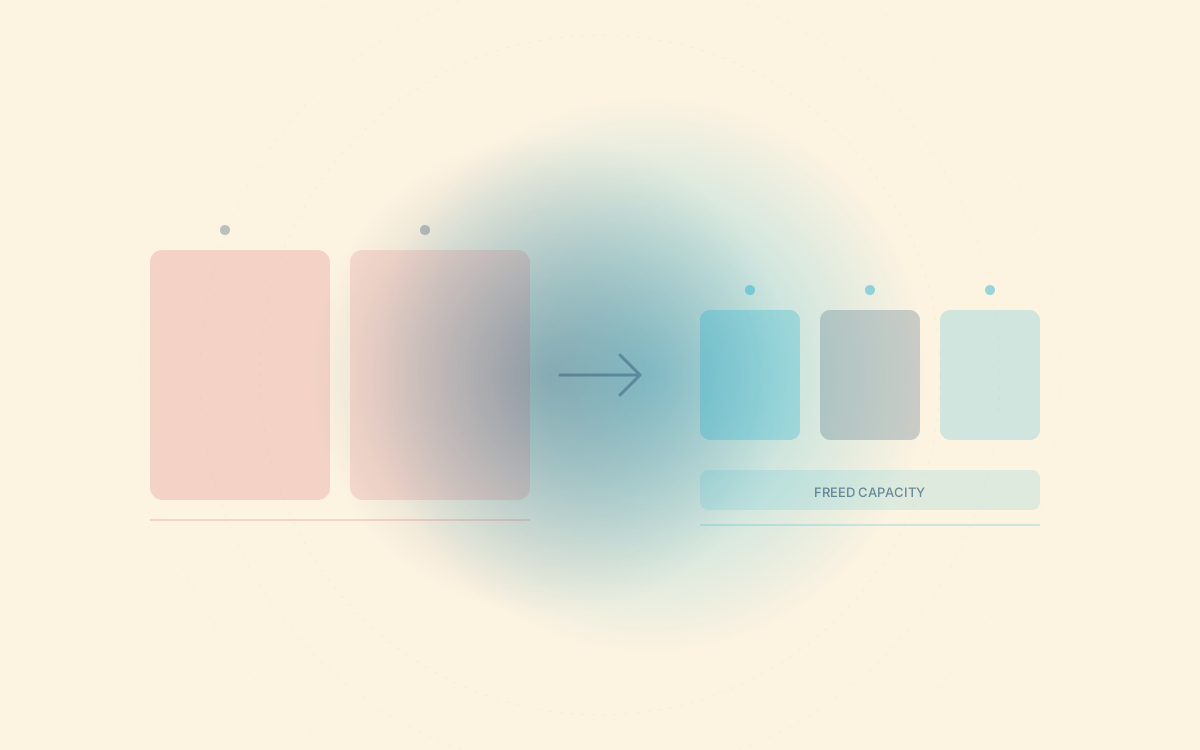
The full clinician-facing assessment time fell from 120 minutes to 44 minutes. The clinic recovered about 71 hours of capacity in one month.
The same direction shows up across our deployments. At a community mental-health center running Mira on the Mental Health Assessment, clinician listening time fell from a 45–60 minute traditional baseline to 19.3 minutes. Every measured session came in below the lower bound of the legacy range.
Different sites. Different measurement frames. The same 63% reduction in clinician time.
Two-thirds back is a capacity story
A clinician working a 40-hour week has 2,400 minutes of clinical time. At a 120-minute appointment block, that supports 20 assessments per week. At the 44-minute clinician time observed with Mira in place, the same 2,400 minutes support 55. The bottleneck moves from typing speed to clinical judgment, which is where it always should have been.
Internal testing indicates Mira's pre-assessment content extends to 45–60 minutes without affecting patient satisfaction — transferring another 15–30 minutes of assessment load off the clinician and putting a 60+ assessment-per-clinician-per-week ceiling within operational reach.
The clinician sees the patient first
Mira handles the structured-data portion of the assessment before the clinical hour begins. The clinician walks into the room with the chart already loaded, the symptom scales already scored, and the identity questions — gender identity, pronouns, sexual orientation — already absorbed by the agent. The clinician's first impression is built on clinical content, not on identity navigation.
Patients give Mira an NPS of +21 across 34 rated sessions. Half rated 9 or 10 out of 10. The strongest detractor cluster traced to noisy session environments, not to the assessment content itself — an environmental fix you make once, not a product redesign.
Risk handling stays with the clinician. The C-SSRS, the PHQ-9, and the clinician-led assessment remain the safety channels. Mira surfaces risk items and routes to a clinician on any positive signal. The platform is not in the business of replacing clinical judgment. It is in the business of giving clinicians back the hour they were trained for.
The upside
It is not "AI doing the clinician's job." It is the clinician finally being free to do their own.
See Mira in your clinic. psyrin.ai